

One of the significant developments with the widespread adoption of the personal computer for home, business, and school use is the digitalization of media and the subsequent mass adaptation by consumers and industry. While digital media is not a new concept, it has only recently made its way into the “normal” household and is commonly supported by digital audio cables. As a result, higher quality audio playback is now supported while watching movies or listening to music that can approach (or at times exceed) the experience found in a high-end movie theater. While architecting the perfect home or work audio setup, some consumers neglect to identify the proper digital audio cable (vice analog) to use in their respective entertainment system.
What Are the Types of Digital Audio Cables?
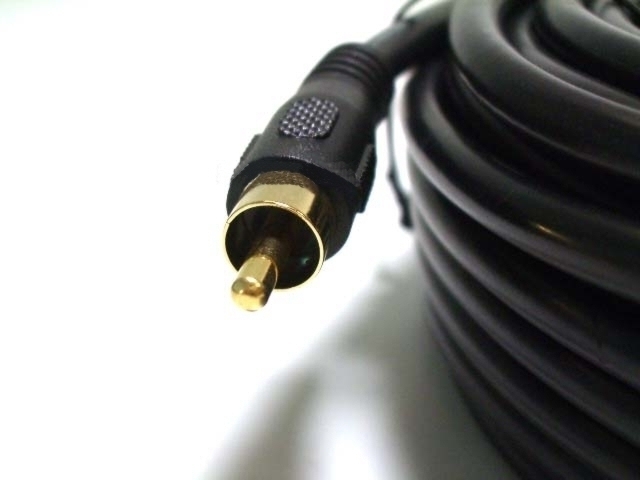
The two most common types of digital audio cables are coaxial and optical digital audio cables (also referred to as S/PDIF). Coaxial digital cables are the more commonly found type of cable and are very similar to the legacy, RCA analog type which most consumers have experience using. The primary difference between RCA and coaxial tends to be the thicker shielding required in the cable to prevent interference from outside noise sources.
How Do Coaxial Digital Audio Cables Work?
Coaxial digital audio cables allow signals to be transmitted in pulses of electricity through copper wires that are contained inside of the housing of the cable. The coaxial cable contains aluminum wraps that are engineered to block outside signal interference. The typical impedance for audio applications is 75 ohms and the cable type permits a larger overall bandwidth than an equivalent RCA cable. For the average home consumer, coaxial cables cost less than the optical S/PDIF type and are the most commonly used for home or personal digital audio needs as a result.
How Do Optical Digital Cables (S/PDIF) Work?
The other type of digital audio cables are optical digital cables or as they’re more commonly referred to S/PDIF. These cables are completely different from any kind of cable most people know since they do not make use of a conductive metal such as copper. Instead, S/PDIF cables use pulses of light to transmit signals. The primary advantage to this mode of information is the elimination of radio and electromagnetic interference. As a result, the cables do not require as thick of shielding as the coaxial type. Another advantage of the S/PDIF type is that there is no degradation of signal over distance resulting in the same quality of signal exiting the cable as entering it. As a result, many audiophiles prefer the use of optical cables over coaxial. One significant shortcoming of the cable type is that if the optical cable gets bent, it can become damaged if installed in a high traffic area. The majority of modern audio components are built with ports for both S/PDIF and coaxial cable inputs and outputs.
HDMI Cables
HMDI (High Digital Multimedia Interface) cables have traditionally been used to carry digital video. They are also capable of transmitting audio; however, this is most commonly associated with the audio tracks most commonly associated with the video. HDMI ports are found primarily on DVD players, HDTVs, and some personal computers. The cable can support up to 5 gigabytes per second of bandwidth so it is able to transfer from the source (high definition DVD player) to the your HDTV a pure A/V signal without any compression of the signal. Ultimately, HDMI may replace all digital audio cables as support for the cable for audio components as it reduces the need for separate video and audio cabling. Although HDMI usage has been increasing, many components are still being produced which only use the HDMI port to send or receive video and have not yet hit the mainstream for digital audio usage.
How to Choose Between Coaxial and S/PDIF Cables?
If your components support both coaxial and S/PDIF digital audio cables, a common decision point that consumers have to make is which cable type to purchase. Some common considerations are:
1 – The amount of electromagnetic interference in the environment. If your cables will be run near other power cords or a personal computer that transmit radio frequency noise, then an optical cable will have better performance than coaxial.
2 – Distance or length of audio cable to be used. Optical cables provide better sound quality over distance when compared to coaxial. If you need to run speaker wire for distances exceeding 10 feed, then optical cables will provider higher sound quality.
3 – Budget. For consumers who are approaching, met, or exceeded the budget for a home entertainment system, coaxial cables will be a more economical choice when compared to S/DIF.
4 – Sound set-up requires cables to be bent. If your specific entertainment set-up requires the cables be bent, coaxial cables will be the preferred choice.
5 – Sound system will be moved frequently. If the sound system will be moved frequently, the possibility of optical cables being damaged significantly increases. As a result, coaxial cables will be the preferred choice.
Other Factors to Consider when Choosing Digital Audio Cables
Listening Environment
A significant factor to consider before spending money on more expensive audio cables is what type of environment the cables will be used. If the audio system will be used in an environment with a significant amount of background noise, it will be harder for most consumers to tell the difference in quality between coaxial and S/PDIF cables. If the consumer is older, paying consideration to one’s actual hearing capability should also be made. If one cannot tell the difference in sound output in the store (between coaxial and S/PDIF cables), then the likelihood of doing so in the home is low.
Speaker Quality
Another common mistake made by consumers when choosing digital audio cables, is ignoring the quality of the entertainment system’s speakers. If possible, testing the performance of speakers with each type of cable is recommended before spending money on the more expensive optical cable.
Quality of Audio Content
Another common mistake made when choosing digital audio cables is the quality of the music media itself. Many a consumer has purchased high-end audio equipment at the store along with optical cables and then plays music from low-quality sources such as YouTube, converted MP-3s, and other non-digitally sourced music. Just because a song has been ripped to MP-3 or even MP-4 does not mean it has been produced to the quality required to take full advantage of a high-end audio playback or entertainment system.
Digital Audio Sources
The majority of music legally purchased or downloaded online is in a “lossy” format. MP3 and the 128 kbit/s AAC format found on iTunes are lossy containers. Although this quality of recording is sufficient for playback on less expensive audio systems or MP3 players for pop music, it is not the highest quality of recording available. For a truer or better audio experience, the digital audio track needs to be recorded in a lossless format such at FLAC with an encoding of 320 kbit/s.
The problem is getting that high quality audio, which is ironically harder to do today than it was in the days of analog audio. The majority of music popular with the public is either not available in a lossless format, or costs additional money to purchase. If you already have a significant MP3 or music library, it can prove cost prohibitive to repurchase the same music in the higher quality.
If the consumer only listens to popular music; however, his or her ears may not be able to tell the difference in encoding rate. The sound differences with encoding options are easier for the average person to differentiate while playing back classical music on the audio system. Before expending significant funds to acquire a new music library, consumers should actually test several songs of the preferred genre encoded at the 128 and higher rates to see if there is a noticeable performance difference.
Supporting FLAC Audio Playback
Before spending a significant amount of money on purchasing music encoded in FLAC format, consumers will need to ensure they have an encoding program that supports FLAC. Two of the more popular, free, options for encoding music in this format include Audacity and the VLC Media Player. These applications are generally operating system agnostic and support computers that run OS X, Windows, and Linux operating systems. Other cross-platform playback options include MPlayer and Songbird. Popular Linux specific players include Banshee and Audacious.
Digital Audio for Movies
When designing or purchasing a home entertainment system, the quality of audio playback should be considered to provide an enriching audio experience to complement the HD playback of movies. The DVD/Blu Ray player will need to support digital audio in order to best leverage a high-quality sound system for movie viewing. When choosing a player that supports digital playback, consumers need to ensure it supports a digital audio cable connection that is compatible with the audio playback system. The majority of HD movies that come on disc or are purchased online also support digital audio.
sam
Can someone help me? or tell an idea where can be the problem? when I play audio from PC on 192 khz 24 Bits through optical toslink the sound is great but it cuts sometime more sometime less .. can be probelm somewhere in optical cable? my reciever also recognize 192 khz audio source
Renjith
“For a truer or better audio experience, the digital audio track needs to be recorded in a lossless format such at FLAC with an encoding of 320 kbit/s.”
FLAC in-fact preserves the original bit rate is what I thought.
Slackware
Where can you find fiber wall plates so you can run them through the wall up to the tv?
I can’t get the digital audio out to the stereo, and am stuck using the bluray to do web apps. ughh!
Why can’t they use the network design connectors, you can get those plates anywhere.
And the fiber does wonders in your car stereo, shame it limits your choices so much.
Fredolaz
People who say they don’t notice a difference between digital and analog just don’t have an high-end souns system. Nothing in big surfaces is considered as High definition. You must go in special stores wher you can purchase real hi quality stuff (a pair of speaker of 2000$ to 50000$ for example! Then with a Chord amplifier (6000$) you will notice difference between 5$/feet speaker cable and 100$/feet cable! And even power from wall outlet, and of course the quality of the source (cd player, blu-ray reader, etc.)
(I don’t say by the wa that digital is always superior to analog. Thos who say that just don’t understand the difference and why vinyle discs are coming so popular again).
High quality cables just transmit better the information. The guy that said that a 5$ equals a 100$ cable (for digital) maybe he can check his source to be sure that there is never loss in transmitting the digital signal. If they do better decoder in DVD player or CD player it’s because it’s faster to decode and it gets more information.
Johnny P
@Russ
As far as “break in time” goes, from a physics point of view, yes there is some break in time for any metal used to carry current. There is generally a period of time from initial use where the conduction of electrons through molecules causes them to basically “line up” reducing the amount of resistance in the overall length of the cable, however, the reduction in resistance is so minute, not only would you not hear a difference, the change is barely measurable. Add to this the fact that the metal will eventually become “tired” with age/use which would negate any gains in the first place. Once again, not a noticeable change. So in all, it sounds like that comment was from yet another uninformed person.
sriram
Please let me know the top brands of fiber optic cables
Don
I was hoping to find a legitimate answer to my question concerning Optical Digital cabling. However, based on the comments left on this so called forum, I am advertising this link as useless and non-credible. Enjoy your pissing contest.
Russ
I am not one of those fools who would spend 100’s or even 1000’s of dollars on 1 meter cable. If someone thinks that they can actually discern the (sound) difference between a $20 cable and a $1000 cable, you are kidding yourself. You are making other peoples’ wallets fatter while your wallet shrinks. Now, to get to my question: Do audio cables require a “burn-in” period? How on earth is a cable going to become better with age? I saw a comment where some guy stated that his high-end cables required 250 hours of break-in. Is there any credibility to this thought? It sounds like a crock to me.
Jim
If you only have the digital audio output on your tv, is there a cable adapter to convert from the digital output to an analog cable to connect a wireless headset device?
Simon
If you guys have no positive comments or nice things to say how about just STFU!!!
Vegas Jack
I’ve tried the most & least expensive digital audio coaxial audio cables on the market, noticed NO difference in sound quality between the high priced & low priced cables. I also tried using a cheap standard analog RCA Video cable connected between my Blu-Ray player and my JVC receiver Coaxial audio ports. The results, zero difference in sound between digital coaxial audio cable and the cheap RCA analog cable.
Sara
Thank you for this information. I have a big box of cables, but no orange colored digital coaxial audio cable. I wanted to avoid purchasing another cable that eventually goes unused.
gregg
which cable is it that as a rca plug on one end an a spdif plug on the other end.
Simple Bob
Nowadays DAC boxes are commonly purchased separately because, simply put, the analog sound they put out is superior to your existing source’s DAC be it from your cd player, squeezebox, or ipods. In order to use these external DAC boxes you will need to use a digital cable, normally either optical/toslink cable or coaxial rca cable. You will note, however, in the DAC’s specs that the resolution for conversion is different for these cables. For coax the DAC will work at 24/192 full-on conversion while if you use optical it will only work up to 24/96 conversion fed with the same 24/192 digital signal input. Seems to me rca coax cable is superior to optical if this is the case.
toxeed
slt a tous, je cherche un cable (digital out coaxial) vers (s/pdif rca) , je trouve nul part ni magasin ni sur internet …es ce que ca existe ???
gwen
I have a dumb question. What exactly is an optical digital audio cable used for? Please answer in layman’s terms. I have a Bose media center connected to my TV – someone last year thought it would be a good idea to add one of these, I can’t remember why but it sounded good at the time – needless to sy I purchased one and do not know how to connect it or really the reason for it – my friend has since returned to Pluto (that is a joke) – can someone please help me out. I have a Dynex brand 6.0 ft cable. Thanks
Don
Simply put, optical digital audio cables transfer digital audio signals between the source (your media center) and the output device (your sound system). It has better audio quality than normal analogue cables (the red and white cables) and carries surround sound. Make sure your sound system has an optical digital aka S/PDIF input.
richard
a cheap way to do this is to solder the center copper wire to the connector ,and make sure the aluminum foil and wire shielding make good contact with the outer side of the connector . but the best result would be to use a two wire cable and solder both .
Brandon
Looking for an affordable way to extend a digital audio coax 50-75 feet. Can I use an RCA-coax connector on both ends, with a standard (TV) coax cable in-between? The only connectors I found for this say they are MONO. Does MONO matter if all of the sound is just using one cable anyway? Versus RCA where it is split.
richard
you can just use standard coax cable for the entire distance and use rca type connectors on the ends . i have been making my own digital cables this way for some time with good results
buttcat
actually, none of you freaks know what you’re talking about. Maybe you should listen to the water running before you leave a comment
chris
JR – if your landlord really does run the soundboard my guess he is using AES/EBU digital cables, not Coax or toslinks. But to add, a lot of the equipment used at live concerts would be completely unacceptable for in-home satisfactory performance. Most professional equipment is made for durability, high power (usually class D) and reliability – more than for great sound reproduction.
JR
You would be correct Chris,
PS: I have better things to do than to make up stories to put on forums :-).
JR
My landlord does the soundboard for concerts and has a high-end setup in his home. His comment when asked were pretty much identical to the article. Thanks for the laugh RP.
Buster Hymen
Originally posted by RP: “Not sure where you get your info. but, Optical/ToshLink cables are NOT what audiophiles use or consider premier cables. They are also, not more expensive. You can spend $5,000 on a coaxial digital cable and $400 is about the max on an optical. Obviously, you’re not into high-end audio.. It’s uninformed writers like yourself that cause a lot of confusion among consumers looking to learn about the world of HiFi. I imagine you think surround sound is also the way to go for music.. c.”
Your comment is by far one of the top 25 sorriest on the internet. Way to show how little you know and try to pass it off as knowledge.
noone
Originally posted by RP: “Not sure where you get your info. but, Optical/ToshLink cables are NOT what audiophiles use or consider premier cables. They are also, not more expensive. You can spend $5,000 on a coaxial digital cable and $400 is about the max on an optical. Obviously, you’re not into high-end audio.. It’s uninformed writers like yourself that cause a lot of confusion among consumers looking to learn about the world of HiFi. I imagine you think surround sound is also the way to go for music.. c.”
Stop drinking the Kool Aid, you may want to increase your Prozac.
Paul
good article! Agree!
RP
Not sure where you get your info. but, Optical/ToshLink cables are NOT what audiophiles use or consider premier cables. They are also, not more expensive. You can spend $5,000 on a coaxial digital cable and $400 is about the max on an optical. Obviously, you’re not into high-end audio.. It’s uninformed writers like yourself that cause a lot of confusion among consumers looking to learn about the world of HiFi. I imagine you think surround sound is also the way to go for music.. c.
Jack
Try to be nice.
Mike W
This guys comment on Co-Ax digital cables is right. Toslink, or optical digital cabling suffers from many problems on signal transfer, reflection, and error correction, that streaming electrical cables do not.
Max
RP, I am really not sure where this information is derived from. There is irrefutable evidence that a digital cable will either perform perfectly or there will be highly distinguishable issues.
However, there is no need to pay anywhere near some of the prices you have mentioned. I shop online at places like http://www.spacehifi.com.au/.
There is of course a thriving audiophile market. However, the very notion of this market is encompassed with snake oil, witchery and narcissism. This makes it perfectly acceptable and somewhat expected to use the word cable and thousands of dollars in a single sentence. However, when logic is introduced, the very concept of spending this amount on a single cable is sheer lunacy.
larry
of course there a difference. I just tried a 15 dollar digital ,then 90 dollar cable. The more expensive cable is warmer.